
The Favored Son
Joseph, loved by his father and marked by unsettling dreams, becomes the target of his brothers’ resentment and is cast into the darkness of a pit—where the future of Israel hangs in silence.

Scripture Reference
Genesis 37:1–24
Out of all of Jacob’s sons—and there were many of them, twelve in all—Joseph was his favorite.
This was not a hidden fact, nor a subtle one.
Joseph was the firstborn of Rachel, the woman Jacob had loved above all others. He had worked fourteen years for her. When she finally gave him a son, that child carried the full weight of Jacob’s affection. Rachel would later give birth to Benjamin and die in the process, leaving Joseph and his younger brother as the last living connection to the woman Jacob had loved most.
And from an early age, Joseph felt that favor.
Jacob gave him a special garment—one that distinguished him from his brothers. It marked Joseph as different, closer, preferred. And though Joseph did not ask for it, he wore it openly.
His brothers noticed.
They worked the fields. They tended the flocks. They carried the dust and sweat of long days. Joseph moved between the tents and his father, watching more than working, listening more than speaking.
Resentment took root in the brothers’ hearts.
That resentment hardened when Joseph began to dream.
The dreams were not abstract. They were clear—and that was the problem.
In them, Joseph stood above his brothers. Not through effort or strength, but by position. His future appeared as one where others bowed to him. When he shared the dreams, he did not mean harm. He spoke with the unguarded excitement of youth. But the meaning was impossible to miss.
In the ancient world, dreams were not private thoughts. They were believed to reveal destiny.
Joseph’s dreams suggested authority.
Superiority.
Rule.
The second dream went even further—placing even his parents beneath him.
That was enough.
To his brothers, the dreams were not imagination. They were a threat. To suggest that the younger would rule the older was an assault on order itself. And Joseph did not yet have the wisdom to know when silence was necessary.
They despised him.
Even Jacob rebuked Joseph for speaking so freely—but he did not dismiss the dreams. He had heard such things before. A future announced early. A promise that did not follow rules. The younger rising over the older.
So Jacob kept it in his heart.
Life went on.
One day, many years later, Joseph’s brothers were sent far from home to pasture the flocks. Days passed without word. Jacob, uneasy, sent Joseph to check on them.
Joseph went willingly.
He walked toward his brothers wearing the garment his father had given him, unaware of how long resentment had been waiting.
They saw him from a distance and began to plan what to do with the dreamer.
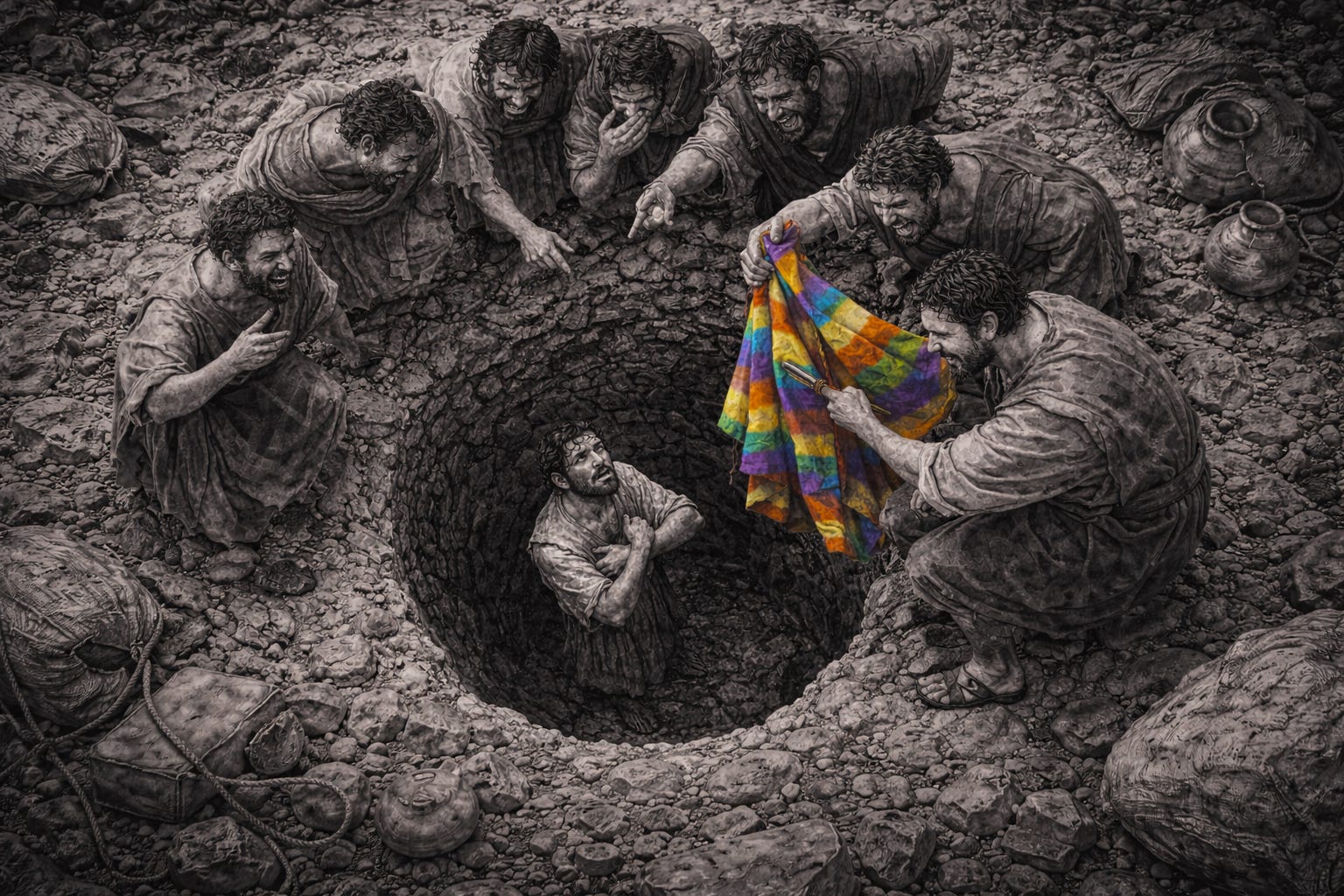
When Joseph arrived, they stripped him of the garment, seized him, and dragged him to a nearby cistern—deep, dry, and empty.
They threw him in.
Joseph landed hard in the darkness below. The light above shrank to a narrow circle of sky. Voices echoed from the edge—sharp with anger—then faded into discussion.
The boy was now alone.
Trapped.
But alive.
The dreams had promised elevation.
Instead, he found himself buried.
And the story leaves him there—
in the dark,
listening,
waiting to see whether his future would end in silence
or begin somewhere he could not yet imagine.
His Story — When the Promise Goes Underground
By the time Joseph is lowered into the pit, the story has traveled a long way.
It began with a promise given to Abraham—land, descendants, blessing—and it has moved forward through imperfect hands ever since. The promise survived famine. It survived barrenness. It survived deception, exile, and even a knife raised on a mountain.
Now it rests with Jacob’s family.
Twelve sons.
One covenant.
And more tension than unity.
What looks like favoritism in Jacob’s household is actually the lingering consequence of a story shaped by loss. Rachel, the wife Jacob loved, is gone. Joseph and Benjamin are all that remain of her. Jacob’s affection does not come from wisdom—it comes from grief. And grief, left unattended, distorts love.
The result is fracture.
Joseph enters the story not as a villain or a hero, but as a mirror. His dreams expose what already exists beneath the surface—resentment, rivalry, fear of displacement. The brothers do not hate Joseph because he dreams. They hate him because his dreams suggest that God’s favor might move in a direction they cannot control.
And that has always been the problem.
From the beginning, the promise has never moved according to human expectations. It does not follow seniority, strength, or consensus. God chose Isaac over Ishmael. Jacob over Esau. Now, unsettling as it is, Joseph appears to be chosen among his brothers.
But the story does not rush to vindicate that choice.
Instead, it takes the promise underground.
The pit is not an interruption of God’s plan.
It is the means by which it advances.
This is one of the most difficult patterns in Scripture to accept: God often allows His chosen servants to be undone before they are established. The dreamer must first be stripped. The favored son must first be forgotten. The one destined to rise must learn what it means to descend.
Joseph’s brothers believe they are ending his future.
In reality, they are sending it ahead of him.
What they intend for harm becomes the path God uses to preserve life—not only for Joseph, but eventually for them as well. But none of that is visible yet. At this moment in the story, there is no rescue, no explanation, no divine commentary.
Only silence.
Only a pit.
Only a young man holding onto dreams that now feel like betrayal.
And that silence matters.
Because Scripture refuses to give quick answers here. It invites the reader to sit in the darkness with Joseph and learn something essential about how God works.
God is not absent when the promise disappears from sight.
He is often most active when it does.
The covenant does not advance in straight lines. It moves through rejection, delay, and apparent failure. Again and again, God allows what looks like loss to become the womb of deliverance.
Joseph will rise.
But not yet.
First comes the pit.
Then the prison.
Only later the palace.
And through it all, the same God who met Abraham on a mountain and Jacob in the night is quietly shaping a future no one in this moment can imagine.
The promise is still alive.
It has simply gone underground.
Upgrade to step behind the story and discover how the ancient Jewish worldview understood descent, silence, and hiddenness—and how Joseph’s fall prepares us to recognize the kind of Savior God has always been sending.